Explore All Blog Categories
Personal
Marketing
Fonts & Colors
Web Design
Blog Home
Personal
Marketing
Fonts & Colors
Web Design
blog Home
Running a business solo means your time is your most valuable asset, and wasting it isn’t an option. These four solopreneur tips have genuinely transformed how I manage my workload, so I can focus on what actually grows my business. No affiliate links, no fluff. Just the tools and habits I rely on every single day.
I’m Emily, a Showit website designer and solopreneur based in Worcester, MA, and the founder of Blue House Creative Company. I started my business after leaving a career in retail management and visual merchandising to stay home with my twin boys. I went back to school for my MBA, dove deep into web design, and built a business around creativity, strategy, and getting things done. This blog is where I share the solopreneur tips, tools, and systems that actually work in the real world of running a business on your own.
Whether you’re just starting out or looking to level up your systems, these solopreneur tips will help you work smarter, stay organized, and finally stop feeling like you’re always one step behind.
Tip #1: Use AI Tools to Eliminate Time-Consuming Tasks
One of the most impactful solopreneur tips I can offer is to start using AI: specifically ChatGPT, Claude by Anthropic, and Midjourney. Together, these three tools cover a huge range of tasks that used to eat up hours of my week.
ChatGPT is great for generating outlines, refining copy hooks, comparing SEO tactics, brainstorming website template names, and even more personal uses like recipe substitutions and dream analysis. Just know that it can sometimes be overeager and needs strong direction, especially for longer content.
Claude excels at editing longer documents and generating substantial amounts of polished copy. I use it regularly for Instagram captions, Pinterest pin copy, blog editing, alt image text, meta titles, and summaries. My go-to workflow: write a rough draft, then use Claude to refine readability, fix grammar, and maximize keyword usage.
Midjourney is my newest AI addition, and it’s been a game-changer for sourcing brand-appropriate visuals without the endless stock photo rabbit hole. I use Claude to write my Midjourney prompts, which has dramatically improved my results. Here’s a recent example:
“Blonde woman walking on a bright minimal coastal patio, looking at iPhone in one hand and iced coffee in the other, weathered cedar shingle exterior walls, hydrangeas, blue striped outdoor cushions visible in background, cropped below the neck, editorial lifestyle photography, photorealistic”
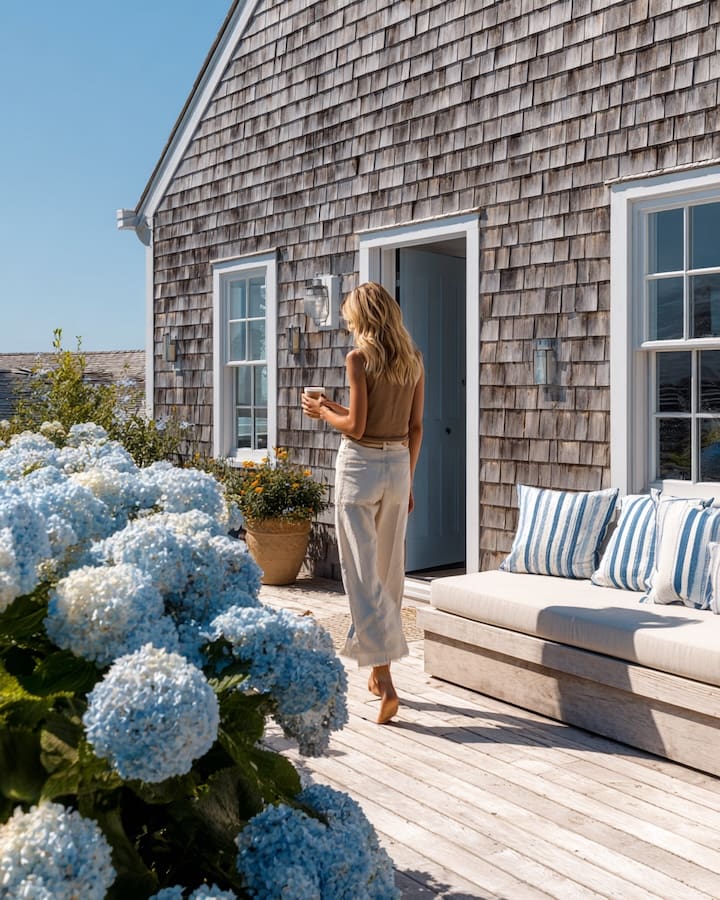
Using AI strategically for the less creative, more mechanical tasks has saved me more time than any other solopreneur tip on this list.
Tip #2: Centralize Everything in Notion
If there’s one solopreneur tip that will immediately reduce your mental load, it’s this: get all your information out of your head and into one place. For me, that place is Notion.
I’m not a Notion expert (I still have plenty to learn), but even at a basic level it’s transformed how I operate. I use it for content planning, course notes, business organization, and tracking the different moving parts of my work. The seamless sync between desktop and mobile means I always have access to what I need, wherever I am.
There are also endless free and paid templates to help you get started. If you’re new to Notion, just start simple. Even a basic content calendar will make a difference.
Tip #3: Design Smarter with Canva
This solopreneur tip is for anyone who doesn’t have a design background (or just doesn’t want to learn Adobe): Canva is your best friend. It’s accessible, affordable, and surprisingly powerful for the volume of content solopreneurs need to produce.
Canva works for social media posts, Pinterest graphics, lead magnets, booklets, pricing guides, branded merchandise, stationery, presentations. The list is genuinely endless. The free version is robust, and the Pro plan (around $15/month) unlocks SVG exports, print-ready PDFs, a larger font and asset library, and the ability to create and sell templates.
If you want a head start, I have a few free Canva templates available for download. Whether you need a moodboard to kick off a creative project or a color palette for branding inspiration, these freebies are built to be immediately useful for solopreneurs. Grab them and make them your own.
Tip #4: Stop Taking Notes in Notebooks (At Least for Business)
This is the solopreneur tip I have to remind myself about daily. I love notebooks (I have a whole collection) and there’s something irreplaceable about physically writing things out when I’m working through an idea. But for business notes, content ideas, and course material? The notebook is where good ideas go to disappear.
When my notes live in Notion or Google Docs, I can actually find them, build on them, and connect ideas across projects. That’s the real goal: creating an ecosystem of content where everything links together. A notebook can’t do that.
The practical habit: if I’m out and have an idea, I add it immediately to Notion on my phone. If I’m watching a webinar or taking a course, I keep notes in Notion. When I’m working through something emotionally or creatively, I’ll still reach for the notebook, but the business-critical stuff lives digitally.
Final Thoughts: Small Shifts, Big Results
These four solopreneur tips aren’t about overhauling your entire operation overnight. They’re about making small, intentional shifts that compound over time. The right tools (AI, Notion, Canva) paired with better habits around how and where you capture information, can genuinely change how much you’re able to accomplish in a day.
As a solopreneur, your energy is finite and your to-do list is not. The goal is to protect your time, reduce friction, and build systems that work for you, not the other way around. Start with one tip, get comfortable with it, and layer in the rest.
You’ve got this.
Have we met yet?
Because I think WE Should be friends
Hi! I'm Emily. I'm a stay-at-home mom who accidentally learned web design while growing my side hobby. When I wanted a website for the Etsy shop I was outgrowing, I realized that learning how to do-it-myself was way more fun than anticipated. And that's how Blue House Creative Company began.
Explore All Blog Categories
Personal
Marketing
Fonts & Colors
Web Design
Blog Home
Personal
Marketing
Fonts & Colors
Web Design
blog Home
Here's What to Read Next
Fonts & Colors
9 Elegant Google Fonts You’ve Probably Never Heard Of
WEb Design
Basic SEO Website Design Tips for Your Showit Website
Web Design
What to Look for in a Showit Website Template
Fonts & Colors
Handwritten Google Font Inspiration For Your Spring Projects


Explore categories
WEb Design
Fonts & Color Inspo
Marketing
blog Posts to binge & save
Explore Catagories
From web design basics, design inspiration, digital marketing tips and tricks i've learned along the way, to the personal posts that let you know you are not alone. It's all here.
Personal

Take a freebie
One full landing page
Free Landing Page Template
Help is on the way!
Free Bio Links Template
Start Here
Free Launching Soon Template
All of the Freebies
Pick one or pick them all
Are you ready for a new website? Or maybe ready for your first website? These freebies will get you started without the overwhelm on a full website. A Launching Soon Page, a Links Page, and a Landing Page. All ready for you.


